

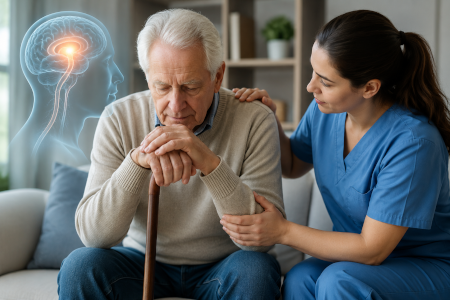
The early symptoms of Parkinson’s disease are often attributed to age. Slower movements, balance issues and slurred speech might be seen as natural, expected changes that require simple lifestyle adaptations.
Yet without adequate intervention, these minor issues can become a major concern that greatly impacts safety, sensory perception and communication.
Because Parkinson’s disease has no cure, sharing the emerging symptoms with your doctor can allow them to begin the diagnostic process and develop a care plan to slow the condition’s progression.
What Is Parkinson’s Disease?
Parkinson’s is a degenerative neurological condition that affects how the body moves. Its progression damages cells that play a key role in how your nervous system regulates muscle activity, cognitive processes, mood and sensory perception.
Although the average age of onset is around 60, hereditary factors can lead to the development of Parkinson’s disease at any life stage. While uncommon, symptoms may begin as early as one’s 20s.
One million Americans across the lifespan, as well as one percent of global seniors, live with Parkinson’s disease. These statistics make it the second-most common neurodegenerative brain disease and the most prevalent movement disorder.
How Parkinson’s Disease Affects the Brain
Parkinson’s affects an area of the brain called the substantia nigra. Part of the basal ganglia, this dark-tissue region is a top producer of dopamine, a neurotransmitter that regulates muscle movement and pleasure reception.
As we age, these cells start dying but for Parkinson’s patients, the rate exceeds the normal pattern. This development is often accompanied by additional changes to the brain, including:
- An elevated presence of Lewy bodies plus alpha-synuclein proteins
- Damage to cellular mitochondria, responsible for the body’s energy levels
- Declining dopamine levels, which limit communication across the brain and contribute to slower movements, tremors, depression and, over time, dementia-like symptoms
- Less-active norepinephrine, a neurotransmitter that helps regulate blood pressure and other bodily functions
Early Physical Symptoms of Parkinson’s Disease
Physical symptoms often appear gradually:
- Many patients initially report a minor tremor in one hand, foot or around the jaw
- Experience a physical change where the face shows little-to-no expression
- The body may feel and appear stiff. Arms may hang rather than swing at your side as you walk
- Speech begins to sound softer or less clear and coherent
Untreated or poorly managed Parkinson’s disease can turn into a significant quality-of-life concern, placing individuals at risk for:
- Constipation and incontinence
- Decreased ability to chew, swallow and consume sufficient calories
- Communication limitations
- Gait changes and falls
- Isolation
- Depression
What Causes Parkinson’s Disease?
The causes of Parkinson’s disease typically fall into one of two groups.
Genetic Factors
A Johns Hopkins study found that about 15 percent of all Parkinson’s disease cases can be attributed to genetics, with a child inheriting mutated genes from one or both parents.
Another study published in Neuron found that genetic composition greatly affects how and when symptoms materialize. Siblings who possess different gene variations may develop Parkinson’s at significantly different ages and display varying presentations.
Environmental Factors
Beyond or coinciding with genetics, toxins and other environmental factors may chemically trigger Parkinson’s disease by causing proteins to accumulate in the brain or by harming existing cells. Related exposures include:
- MPTP, a substance found in synthetic and illegal drugs
- Pesticides and herbicides
- Agent Orange, a chemical used during the Vietnam War
- Heavy metals
- Detergents
- Solvents
- Carbon monoxide
- Select medication use
Parkinson’s disease may also be a secondary symptom of another medical condition, such as:
- Encephalitis
- A concussion
- Traumatic brain injury
Risk Factors for Parkinson’s Disease
Considering all potential causes, individuals with at least one of the following characteristics have a higher risk of the disease:
- Age 50 and older
- A parent or sibling with the condition
- Born male
- Exposure to herbicides and pesticides on the job or in their community
Common Symptoms of Parkinson’s Disease
While presentation varies between patients, many report that symptoms of Parkinson’s began on one side of the body before spreading to the other. Severity also isn’t uniform, with symptoms often more pronounced on one side.
Common symptoms include:
- Tremors in the fingers, hands, feet or jaw that were initially dismissed as stress
- Slower movements, including walking, standing and dressing
- Minimal or a mask-like facial expression
- Difficulty blinking
- Stiff, tense or painful muscles accompanied by rigid or sharp movements
- Stooped posture
- Poor coordination and balance
- Forced movements, like reminding yourself to smile
- Soft, slurred, monotone or incomprehensible speech
- Cramped, small writing
- Sleep changes, such as periodic limb movement disorder (PLMD), rapid eye movement (REM) behavior disorder or restless legs syndrome
- Incontinence
- Difficulty remembering or processing concepts
- Persistent fatigue
- Anxiety and depression
- Constipation
- Drooling
- Difficulty swallowing, or experiencing a choking sensation
- An increase in pneumonia cases
- Diminished senses, especially smell
Along with a combination of these symptoms, Parkinson’s patients often live with:
- Orthostatic hypotension, or a drop in blood pressure when one stands
- Gastrointestinal issues
- Focus and comprehension issues
- Significant nutritional deficiencies
- Joint pain
Diagnosing and Treating Parkinson’s Disease
The diagnostic process often rules out conditions with similar symptoms while using imaging and genetic testing to confirm the presence of Parkinson’s disease characteristics.
Your doctor may recommend:
- Lifestyle Changes: Exercise and consuming caffeine are associated with a lower risk of Parkinson’s disease.
- Medications: Starting on a medication like levodopa can help maintain or increase dopamine levels.
- Experimental Treatments: For patients who no longer respond to levodopa, brain stimulation may help manage more pronounced symptoms.
Care for Individuals With Parkinson’s Disease
From physical and occupational therapies to long-term and memory care, our team understands the challenges of Parkinson’s disease and can help guide your loved one’s care. Explore our services or contact us today for more information.